





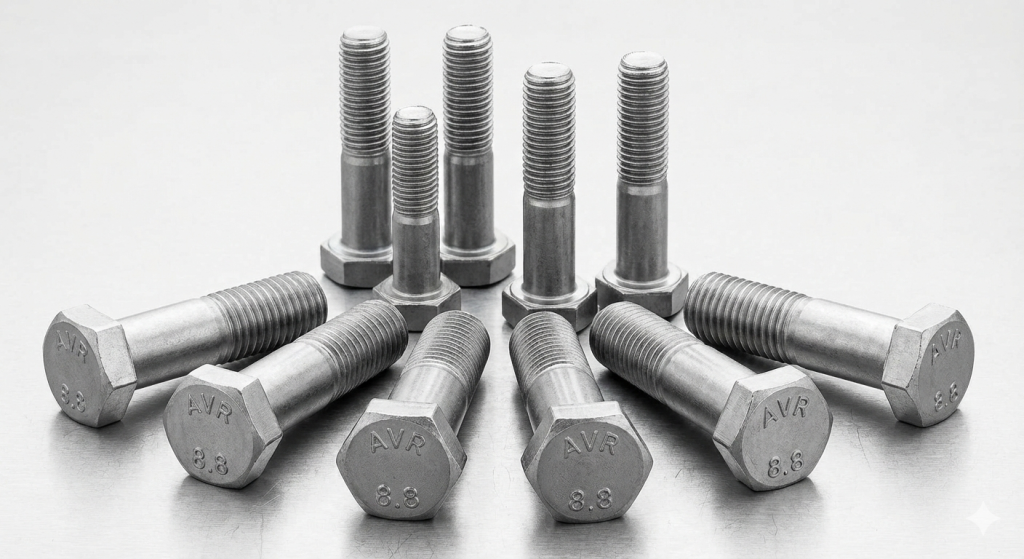
ISO 4014, hexagonal-headed half-threaded bolts definitions. These bolts are manufactured with threads only on part of the shank, and thus high tensile strengths Provides tighter and more reliable assembly in exposed connections. It is largely compatible with the DIN 931 standard and can be preferred in the same application areas. The differences between them are generally related to dimensional tolerances and metric system details. ISO 4014 bolts are widely used in many industrial areas such as flanged system connections, machine assemblies, and steel structure applications.
| Feature | |
| Standard | ISO 4014 |
| Material | Carbon Steel, Alloy Steel, Stainless Steel |
| Type | Hex Head Bolt with Shank |
| Quality | 5.6, 6.8, 8.8, 10.9, 12.9, A2, A4, B7, L7 |
| Coating | Electrogalvanized (White/Yellow), Hot-Dip Galvanized (HDG), Nickel, Black Oxide, Geomet |
| Tooth Type | Metric (Coarse) – UNC / UNF (optional) |
| Measurement Range | M10 to M64, 1/2″-2 1/2″ |
| Production Method | Cold forging, hot forging, or machining |
| Thread Direction | Right-Hand Thread (standard) / Left-Hand Thread (upon request) |
- Heavy-duty machinery and equipment installations
- Flange piping systems
- Steel structure constructions
- Automotive and construction machinery manufacturing
- Refinery, power plant, and petrochemical plant
- Reinforced concrete anchoring systems
- ISO 9001:2015 Quality Management System
- ISO 14001:2015 Environmental Management System
- ISO 45001:2018 Occupational Health and Safety Management System
- EU Declaration of Conformity (PED) certificate (Compliance with the Pressure Equipment Directive)
- Our production processes, DIN, EN, ISO, and ASTM is fully compliant with the standards
- Upon request EN 10204 3.1 certificate is provided
Although the two standards are largely the same, ISO 4014 is more up-to-date and has international validity.
It is a standard. There may be slight differences in tolerances and dimensional details.
A half-threaded design allows part of the bolt's body to be threadless. This enables higher
It can withstand tensile loads and works more securely in the assembly of sensitive parts.
Coating is applied to increase the corrosion resistance of bolts and, in some cases, to provide an aesthetic appearance. The most common coatings include electrogalvanizing, HDG (hot-dip galvanizing), nickel plating, and Geomet.

 Türkçe
  English
  Русский
  Deutsch
  العربية