





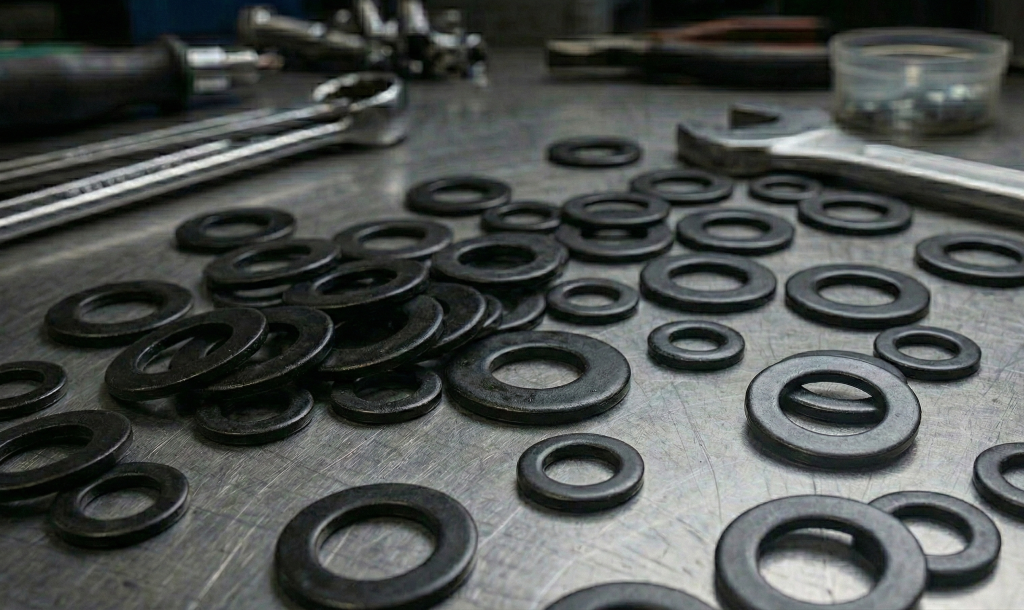
ISO 7091, Although DIN 125 washers have similar dimensions to DIN 125 washers, the main difference is that the manufacturing tolerances are wider and the surface precision is coarser. Generally used with bolts of grade 8.8 and below in steel construction, construction and general assembly applications where precision is not so critical. Due to its “Grade C” construction, hole diameter and OD tolerances are more flexible, which facilitates the application of thick coatings, especially Hot Dip Galvanized (HDG), and prevents jamming in assembly.
| Feature | |
| Standard | ISO 7091 |
| Type | Flat Washer |
| Material | Carbon Steel, Stainless Steel |
| Coating | Electrogalvanized (White/Yellow), Hot-Dip Galvanized (HDG), Nickel, Black Oxide, Dacromet, Geomet |
| Compatible Standards | ISO 4014, ISO 4017, ISO 4032 |
| Measurement Range | M5 to M64 |
| Production Method | Pressing |
- Steel construction structures and roof trusses
- Construction and scaffolding fasteners
- General machine assemblies that do not require precision
- Outdoor applications requiring hot-dip galvanizing
- Prefabricated structures and railing systems
- ISO 9001:2015 Quality Management System
- ISO 14001:2015 Environmental Management System
- ISO 45001:2018 Occupational Health and Safety Management System
- EU Declaration of Conformity (PED) certificate (Compliance with the Pressure Equipment Directive)
- Our production processes, DIN, EN, ISO, and ASTM is fully compliant with the standards
- Upon request EN 10204 3.1 certificate is provided
The most important difference is production precision. DIN 125 is produced very precisely and smoothly, while ISO 7091 is produced with coarser tolerances. The bore and OD of ISO 7091 is slightly more variable than DIN 125, which makes it more economical.
The hot-dip galvanized coating is thick. Precision washers have a narrow hole and the bolt may not pass through when galvanized. Since the hole tolerance of ISO 7091 washers is wider, the bolt passes through easily even with a thick galvanized coating. It speeds up assembly.
Although not a mandatory rule, one side of the washer is slightly rounded due to the punch entry and the other side is sharp. It is best to mount with the rounded side facing the bolt head and the sharp side facing the material.

 Türkçe
  English
  Русский
  Deutsch
  العربية