





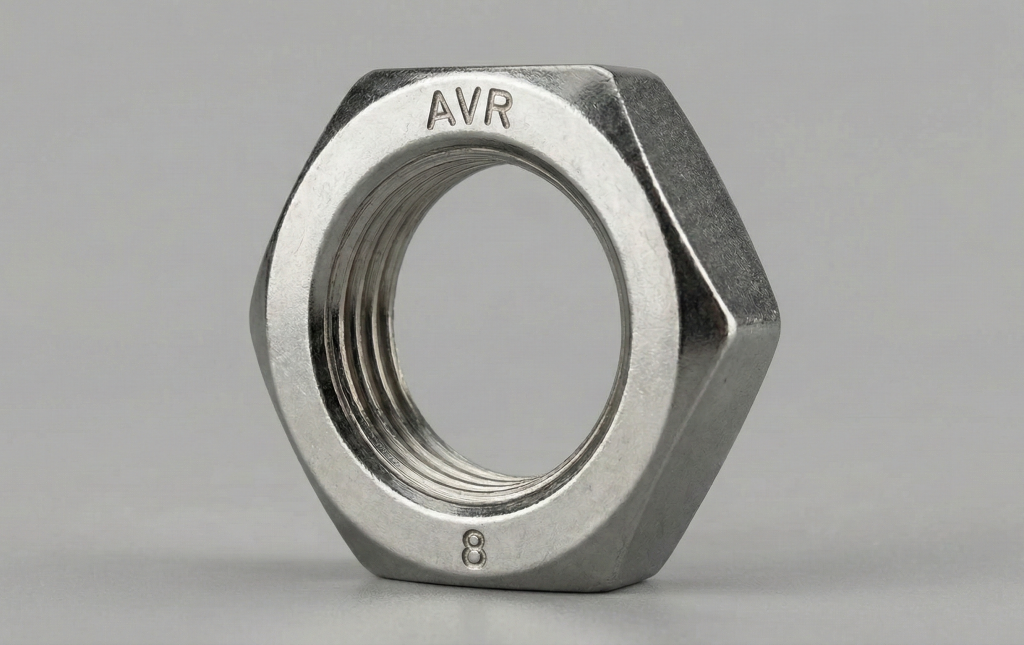
Manufactured in accordance with DIN 936 standard lock nuts, Designed with a low-profile hexagonal structure, it provides connections in confined spaces. It is typically used with a second nut to prevent bolts or screws from loosening. Thanks to its compact design, it is widely used in machinery and equipment, particularly in applications where mounting space is limited.
| Feature | |
| Standard | DIN 936 – Hexagon Lock Nut |
| Material | Carbon Steel, Alloy Steel, Stainless Steel |
| Material Quality | 4, 5, 6, 8, 10, 12, 14, A2, A4 |
| Coating | Electrogalvanized (White/Yellow), Hot-Dip Galvanized (HDG), Nickel, Black Oxide, Geomet |
| Tooth Type | Metric Coarse Thread, Metric Fine Thread (optional) |
| Measurement Range | From M10 to M80 |
| Production Method | Cold Forging, Hot Forging, Machining |
| Thread Direction | Right-Hand Thread (standard) / Left-Hand Thread (upon request) |
- Places where nut height is critical in tight installation spaces
- Using double nuts on bolts and studs in anti-loosening systems (as lock nuts)
- Machine manufacturing and equipment assembly
- In the automotive industry, particularly in chassis and suspension parts
- In construction and steel structure connections
- Power plants and piping systems
- Compact connections in the white goods, electrical appliances, and furniture sectors
- As a secondary safety nut in systems operating under vibration or dynamic loads
- ISO 9001:2015 Quality Management System
- ISO 14001:2015 Environmental Management System
- ISO 45001:2018 Occupational Health and Safety Management System
- EU Declaration of Conformity (PED) certificate (Compliance with the Pressure Equipment Directive)
- Our production processes, DIN, EN, ISO, and ASTM is fully compliant with the standards
- Upon request EN 10204 3.1 certificate provided
En belirgin fark yüksekliktir. Standart bir somunun yüksekliği çapın yaklaşık %80’i kadarken, DIN 936 ince somunun yüksekliği çapın yaklaşık %50’si ile %60′ı It is in between. That is, it is much thinner than a standard screw.
The most common purpose is to prevent the main nut from loosening. After the standard nut is tightened, a DIN 936 nut is attached behind it and tightened in the opposite direction. This process creates tension between the threads of the two nuts, preventing them from loosening due to vibration.
Fiber-reinforced nuts are single-use and the nylon inside may melt at high temperatures. Metal-to-metal counter-locking with DIN 936, however, is resistant to high temperatures and can be removed and reinstalled multiple times. For this reason, DIN 936 is preferred over fiber in engine and exhaust connections.

 Türkçe
  English
  Русский
  Deutsch
  العربية