





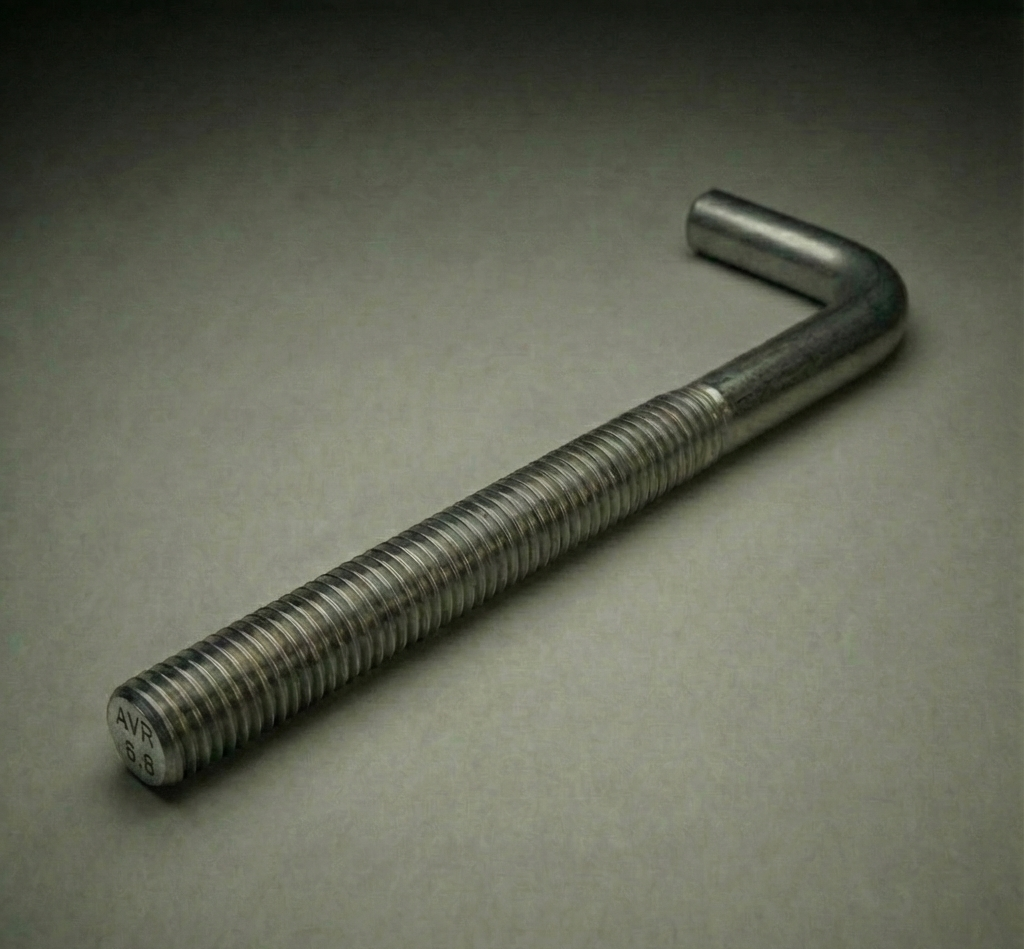
L-Type Anchor Bolt, These are steel rods with one end bent, used for connections requiring permanent anchoring in reinforced concrete structures. The bent portion (L-shape) remains embedded in the concrete, providing high resistance to tension. The upper end is produced with threads and is secured using a nut/plate.
This type of anchor is commonly used in column base plates, machine foundations, steel structures, and heavy industrial installations. Diameter, length, bend angle, and thread lengths can be customized according to project requirements.
| Feature | |
| Material | Carbon Steel, Stainless Steel, Alloy Steel |
| Type | L-Type Anchor Bolt |
| Production Method | Hot bending, followed by tooth cutting (grinding or shaving) |
| Coating | Electrogalvanized (White/Yellow), Hot-Dip Galvanized (HDG), Nickel, Black Oxide, Dacromet, Geomet |
| Tooth Type | Metric Coarse Thread, Metric Fine Thread – UNC / UNF (Inch) |
| Measurement Range | Diameters from M10 to M64, total length 100 mm – 1500 mm |
| Thread Direction | Right-Hand Thread (standard) / Left-Hand Thread (upon request) |
- Heavy equipment anchoring in reinforced concrete foundations
- Steel construction column and beam connections
- Machine and engine undercarriage connection systems
- Wind turbine foundations
- Assembly systems in refineries and petrochemical plants
- Structural connection points in power plants
- Industrial steel structures and crane rails
- ISO 9001:2015 Quality Management System
- ISO 14001:2015 Environmental Management System
- ISO 45001:2018 Occupational Health and Safety Management System
- EU Declaration of Conformity (PED) certificate (Compliance with the Pressure Equipment Directive)
- Our production processes, DIN, EN, ISO, and ASTM is fully compliant with the standards
- Upon request EN 10204 3.1 certificate is provided
L-shaped anchors provide higher resistance to tension due to their L-shaped bend in the section embedded in concrete. Straight anchors, on the other hand, work in conjunction with directly fixed plates.
No. It can be adjusted on a project basis according to tooth length, flange thickness, number of nuts, and washer dimensions.
Yes. It is manufactured in stainless steel grades such as AISI 304 and 316 and is preferred especially in marine structures where corrosion is intense.

 Türkçe
  English
  Русский
  Deutsch
  العربية