





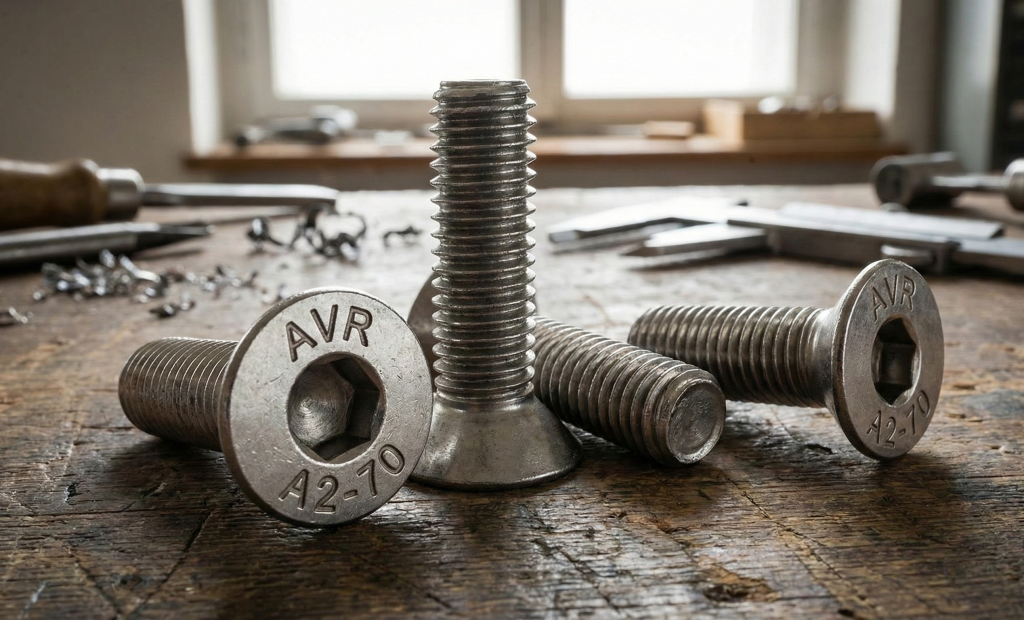
DIN 7991, refers to bolts with a tapered head and hexagonal key slot, designed so that the head is flush with the surface when installed. In the industry “Countersunk Imbus” known as a countersunk bolt. The most distinctive feature of these bolts is that the part needs to be countersunk beforehand for assembly. When the bolt is tightened, the head is embedded in the material and there is no protrusion. This prevents moving parts from catching on the bolt head and provides an aesthetic, smooth appearance. Compliant with ISO 10642 standard. Generally used in machine covers, automotive interiors and precision instruments.
| Feature | |
| Standard | DIN 7991 |
| Material | Carbon Steel, Alloy Steel, Stainless Steel |
| Type | Countersunk Head Imbus Bolt |
| Quality | 8.8, 10.9, 12.9, A2, A4 |
| Coating | Electrogalvanized (White/Yellow), Hot-Dip Galvanized (HDG), Nickel, Black Oxide, Geomet |
| Tooth Type | Metric |
| Measurement Range | M4 to 24 |
| Production Method | Cold Forging |
| Thread Direction | Right tooth (standard) |
- Machine body covers and protective plates
- Sliding mechanisms and slide systems (to prevent friction)
- Automotive interior trim parts and hinge fittings
- Furniture and decoration where aesthetic appearance is important
- Aerospace and defense industry (Aerodynamic surfaces)
- Electronic device safes
- ISO 9001:2015 Quality Management System
- ISO 14001:2015 Environmental Management System
- ISO 45001:2018 Occupational Health and Safety Management System
- EU Declaration of Conformity (PED) certificate (Compliance with the Pressure Equipment Directive)
- Our production processes, DIN, EN, ISO, and ASTM is fully compliant with the standards
- Upon request EN 10204 3.1 certificate is provided
“L” shaped Allen Key is used to tighten these bolts.
Generally used for exterior cladding, boat/yacht decks and food machinery. Since it does not protrude on the surface, it does not retain water and is easy to clean, as well as providing an elegant appearance.
No. Unlike other bolts, countersunk bolts (DIN 7991) are measured from end to end (total length). Because the bolt is completely embedded in the surface, the total area it occupies in the material is important. If you measure incorrectly, the bolt will be short.

 Türkçe
  English
  Русский
  Deutsch
  العربية